




What Is Nonwoven Fabric?
A Brief History of Nonwoven Fabric
Manufacturing Methods of Nonwoven Fabric
Characteristics of Nonwoven Fabric
Applications of Nonwoven Fabric
Nonwoven Fabric Performance
Nonwoven Fabric Q&A
World Nonwovens Industry Association
Japan Nonwoven Fabric Industry Association
Data on Nonwoven Fabric
About
What Is Nonwoven Fabric?
A Fabric That Isn’t Woven — And That’s Exactly Why It’s Chosen.
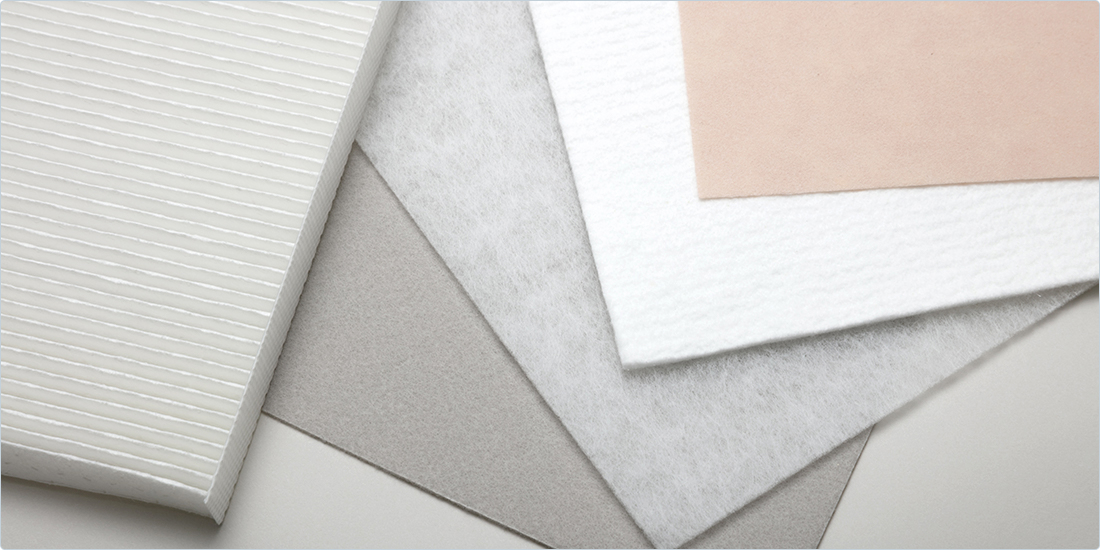
Nonwoven fabric is a sheet-like material made by entangling fibers into a web without weaving or knitting. As the name “nonwoven” suggests, it is literally “fabric that is not woven.” While traditional fabrics are created by weaving or knitting yarns, nonwoven fabrics are made by layering fibers in a specific or random orientation and bonding them using chemical adhesives, mechanical entanglement, water jets, or thermal fusion. One of the key features of nonwoven fabric is its versatility—it can be engineered for softness, breathability, strength, and more. With properties that fall between paper and cloth, nonwoven fabrics are lightweight and easy to process, making them suitable for a wide range of applications, from everyday products to industrial solutions.

Nonwoven fabric

Woven fabric

Knittd fabric
History
A Brief History of Nonwoven Fabric
The Origins of Nonwoven Fabric
Before the invention of techniques to spin fibers into yarn or weave them into cloth, early humans wore materials such as animal hides or softened tree bark. These primitive coverings—made without weaving or knitting—can be considered the earliest forms of nonwoven fabric.
It is said that the first felt—also considered a type of nonwoven—originated when nomads living between the Himalayas and Tibet observed that the wool on sheep’s bodies became naturally tangled and attempted to recreate this process artificially.
The Evolution of Nonwoven Fabric
In the 1920s, felt manufacturers in Germany began producing substitutes for traditional felt by bonding wool waste and short fibers with adhesives. This marked the birth of the first factory-made nonwoven fabric. Research progressed in Germany and the United States, and by applying materials developed during World War II—such as synthetic resins and rubber—modern nonwoven fabrics began to take shape.
In Japan, nonwoven production began in 1954 when a domestic company imported dry-laid nonwoven manufacturing equipment from the United States. This sparked a wave of production across various companies.
In the 1960s, Japan Vilene Co., Ltd. was established as a joint venture between three companys: Carl Freudenberg (now Freudenberg Group) —a global nonwoven manufacturer, Dainippon Ink and Chemicals, Inc. (now DIC Corporation), and Toyo Rayon Co., Ltd. (now Toray Industries, Inc.)
Manufacturing Method
Manufacturing Methods of Nonwoven Fabric
Diversity Created by Manufacturing Processes and the Flexibility to Meet Evolving Needs
As the name suggests, nonwoven fabric is a material made without weaving. Instead, fibers are layered in a loose, unstructured form and then bonded using heat, pressure, water jets, or other methods. This process allows the fabric to be engineered with a wide range of functions.
Nonwoven Fabric Manufacturing Process
Web Formation
01
- Dry-Laid Process
- Wet-Laid Process
- Spunbond Method
- Meltblown Method

Fiber Bonding
02
- Thermal Bonding
- Chemical Bonding
- Needle Punching
- Hydroentangling (Spunlace)

Additional Processing
03
- Dyeing
- Lamination
- Coating

Winding
Web Formation
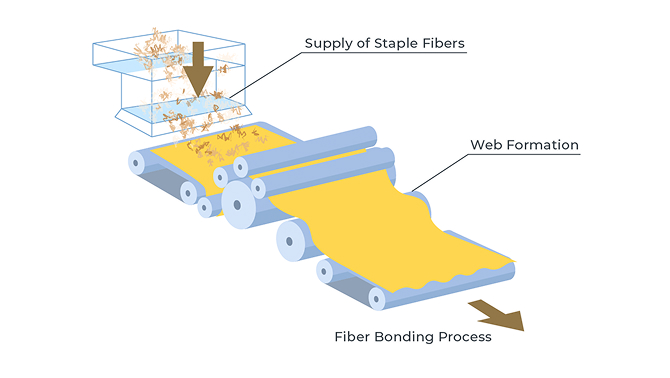
Dry-Laid Process
Short fibers (15–100 mm) are arranged either in a specific direction or randomly using a machine called a card or an air stream known as an airlay.
Features
Lightweight, bulky, and highly breathable. Various methods of fiber bonding allow for design flexibility tailored to specific applications.
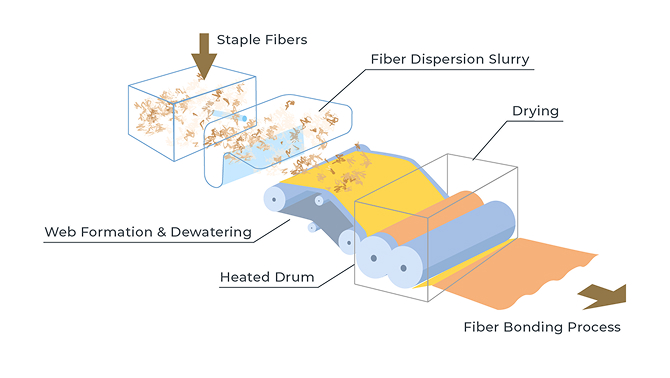
Wet-Laid Process
Similar to papermaking, very short fibers (under 6 mm) are dispersed in water and formed into a web on a mesh screen.
Features
Excellent uniformity in thickness and basis weight
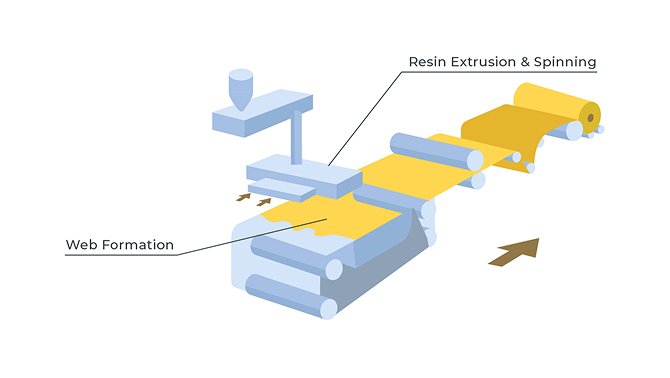
Meltblown Process
Molten resin is blown by high-speed hot air to form ultra-fine fibers, which are layered into a sheet.
Features
Efficient sheet formation directly from resin. Ultra-fine fibers (1–10 μm) achieved through high-velocity air attenuation. Nonwoven structure composed entirely of fine fibers, unattainable by dry or wet-laid methods.
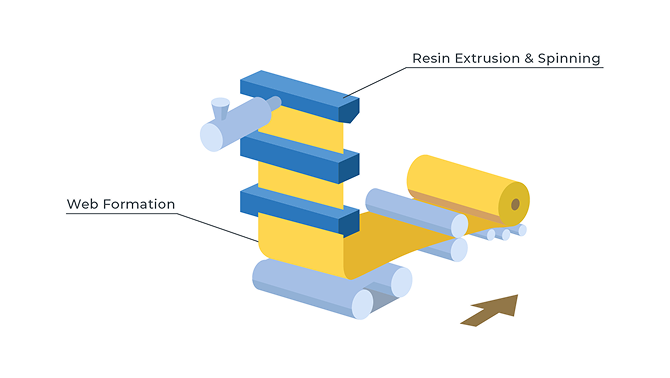
Spunbond Process
Molten resin is extruded into fine filaments, which are cooled, stretched, and directly laid into a continuous web.
Features
Customizable design to meet diverse application needs. applications.
High tensile strength from continuous filaments. Wide-width capability and high-speed production for large-scale efficiency
Fiber Bonding
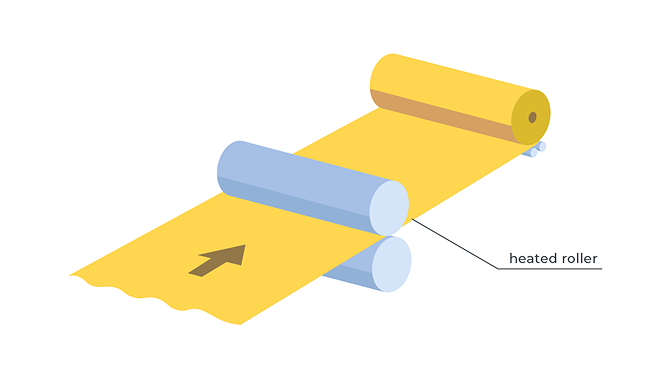
Thermal Bonding
Web containing low-melting-point fibers is passed through heated rollers or exposed to hot air to bond the fibers.
Features
Soft texture without the use of adhesives
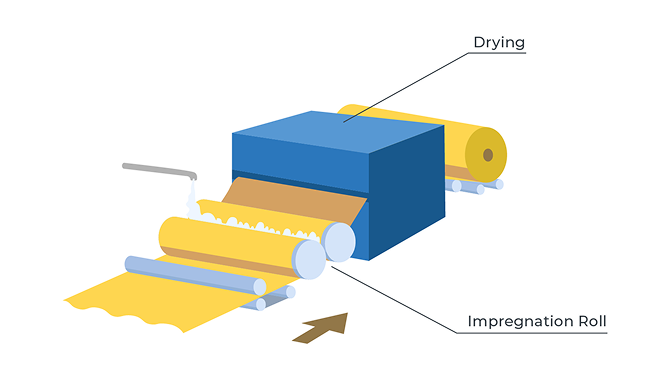
Chemical Bonding (Impregnation Method)
Emulsion-based adhesives are impregnated into the web, then heated and dried to bond fiber intersections.
Features
Enables stiffness and compression resistance
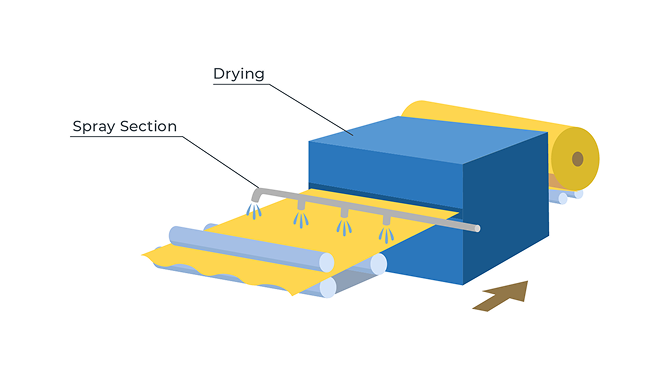
Chemical Bonding (Spray Method)
Binder solution is sprayed onto the web, then heated and dried to bond fibers.
Features
Adhesive is applied only at fiber intersections, allowing for bulky and soft nonwoven fabrics
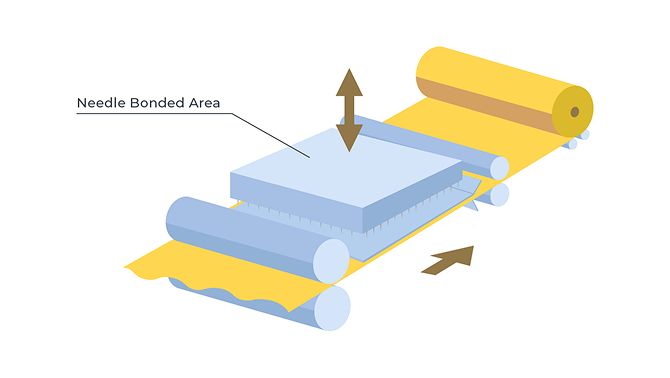
Needle Punching
Barbed needles repeatedly pierce the web, mechanically entangling the fibers into a fabric-like structure.
Features
Highly flexible, with no delamination between fibers
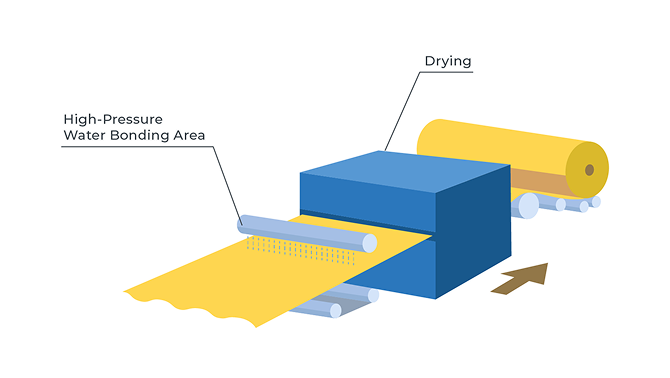
Hydroentangling (Spunlace)
High-pressure water jets are used to entangle fibers and form the fabric.
Features
Soft texture with excellent drapability
Feature
Characteristics of Nonwoven Fabric
A Wide Range of Unique Properties — Defined by Material and Manufacturing Method
Although commonly referred to as ‘nonwoven fabric,’ its physical properties can vary significantly depending on the materials and manufacturing methods used. By optimally combining various functions to meet specific application requirements, nonwoven fabric serves as truly ‘custom-made materials’ utilized across countless aspects of society. Its greatest feature is the ability to freely design both functionality and form as needed.
Common Fibers Used in Nonwoven Fabrics
Polyester (PET)
Heat-resistant and offers excellent dimensional stability. Ideal for applications where strength and durability are essential
Typical Applications:
Medical products, automotive interior materials, construction materials, industrial materials
Polyolefins (PP, PE)
Lightweight and water-repellent, with excellent cost performance
Typical Applications:
Hygiene products, filters, agricultural sheets, packaging materials
Nylon
Lightweight yet strong, with excellent abrasion resistance.
Typical Applications:
Insulation for apparel, filters
Rayon
A regenerated fiber derived from natural sources. Soft with high moisture absorption, making it ideal for skin-contact products
Typical Applications:
Wet wipes, facial masks, sanitary products
Blended & Composite Materials
Combining multiple fiber types to balance performance, cost, and processability. Used to optimize functionality and meet specific application requirements.
Characteristics of Nonwoven Fabric
Advantages
- Fast production speed enables lower manufacturing costs
- Unique properties such as filtration, insulation, and breathability
- Various functional properties can be added through material selection and manufacturing techniques
Limitations
- Repeated use may be limited in certain cases
Use
Applications of Nonwoven Fabric
Close to Everyday Life — Supporting Countless Situations
Though often unnoticed, nonwoven fabric is an essential material in our daily lives. Its applications span far beyond hygiene and medical products, extending into construction, automotive, agriculture, and more. Here, we introduce representative uses by category.
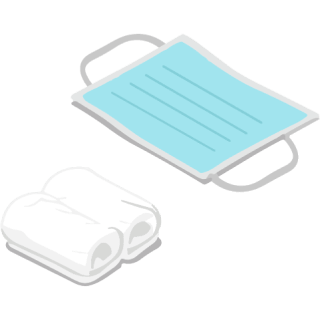
Hygiene & Medical
Transdermal Backing Materials, Respirators, Medical gowns,
Caps, Drapes, Bandages, Diapers, Wet wipes
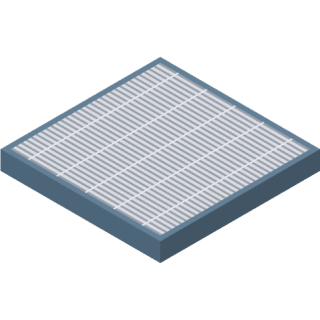
Filtration
HVAC filters, Bag filters, Liquid filters,Cleanroom filters, Residential filters

Automotive
Floor mats, Headliner materials, Door trims,Sound-absorbing materials, Cabin air filter
Industrial Materials
Battery separators, Insulation materials, Components for office equipment, Membrane supports, Roll goods, Tape substrates
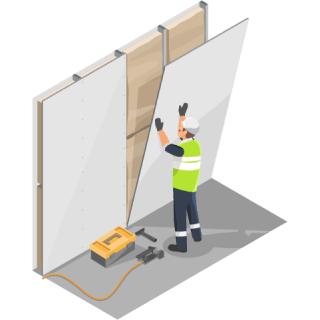
Construction & Civil Engineering
Wall lining materials, Waterproof sheets, Insulation, Flooring underlays, Ground stabilization sheets
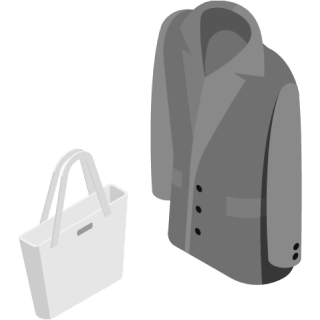
Apparel & Interior
Interlinings for garments, Nonwoven bags, Curtain linings, Bedding components
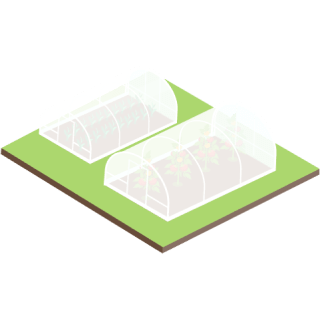
Agriculture & Horticulture
Mulching sheets, Insect-proof nets,Thermal covers, Seedling pots
Household & Consumer Goods
Dish cloths, Wet towels, Wiping materials,
Facial masks

Performance
Nonwoven Fabric Performance
Meeting functional demands with trusted materials.
The diverse functions of nonwoven fabric are made possible through the combination of raw materials, production processes, and converting techniques. Its ability to be precisely designed for specific thickness, basis weight, and performance characteristics is what makes nonwoven fabric a trusted material across industries and everyday life.
Examples of Key Functional Properties

Breathability, Water Permeability, Sound Absorption
Controls the passage of gases, water vapor, liquids, and sound. Essential for nonwoven fabrics used in gas/liquid filters, agricultural materials, automotive materials, and construction materials.

Water Absorption, Hydrophilicity & Water Repellency
Achieved through absorbent carriers or surface treatments. Required for wet wipes, hygiene products, and various surface cover materials. Also critical for battery separators used in electrolytic environments.

Heat Resistance, Flame Retardancy, Weather Resistance, Chemical Resistance
Nonwoven fabrics made with specialized raw materials can offer various types of durability. Essential for applications such as heat- and UV-resistant automotive materials, sputter sheets that block flames and sparks, flame-retardant sheets for railway and aircraft interiors, and construction materials.

Filtration
Required for filters that capture and adsorb dust, impurities, and gases in air or liquid.

Other Key Properties
Flexibility is essential for adhesive materials that smoothly follow joint movements. Shape conformability is required for molded automotive parts. For skincare nonwovens, properties such as skin feel and low irritation are important. Many other performance characteristics are also demanded depending on the application.
Q&A
Nonwoven Fabric Q&A
What is nonwoven fabric? We answer your questions.
“I don’t really know much about nonwoven fabrics.” “What kinds are there?” “Are they environmentally safe?” To answer these questions, we’ve compiled common inquiries in a Q&A format. We hope this makes nonwoven fabrics feel a little more familiar to you.
What is nonwoven fabric? What kinds of products use it?
Nonwoven fabric is a sheet-like material made by entangling or bonding fibers without weaving or knitting. It’s used in a wide range of products, including facial masks, filters, and agricultural sheets.
How is it different from paper?
Paper is typically made from pulp fibers extracted from wood, while nonwoven fabric is mainly made from synthetic fibers. Although the production methods differ, the wet-laid process used in nonwoven manufacturing is similar to papermaking.
Is nonwoven fabric only for single-use products?
Generally, nonwoven fabric is not suitable for repeated use. For example, masks should be replaced after removal for hygiene reasons.
However, some industrial-grade nonwoven products are designed for long-term use and maintain stable performance over time.
Is nonwoven fabric flammable?
It depends on the raw materiala. Some types may burn or melt, but by using heat-resistant materials, flame-retardant and heat-resistant nonwoven fabrics can be produced.
Is it resistant to moisture and water?
Many nonwoven fabrics are resistant to moisture and water, depending on the raw materials. Even those made from water-sensitive fibers can be treated with water-repellent coatings to enhance water resistance.
Is nonwoven fabric bad for the environment?
Nonwoven fabrics are often made from synthetic fibers and require energy to produce.
However, many nonwoven products contribute positively to the environment, for example, by purifying air and water, improving living conditions, preventing infections, and protecting against harmful substances. They are also used in eco-friendly vehicles.
Many nonwoven manufacturers are actively working on environmental initiatives. The All Nippon Nonwovens Association (ANNA), which includes numerous nonwoven manufacturers, promotes environmental awareness, discussions, and information sharing.
Global
World Nonwovens Industry Association
Japan
Japan Nonwovens Industry Association

All Nippon Nonwovens Asscociation=ANNA
| Established | June 1, 1998 |
|---|---|
| Location | 2-5-8 Bingo-cho, Chuo-ku, Osaka 541-0051 Mengyo Kaikan Main Building, 4th Floor |
Data
Data on Nonwoven Fabric
Policies & Structure
Technical Fields
Technology Column
What Is Nonwoven Fabric?
